Newborn Wake Windows: The First 8 Weeks Without Clock-Watching
Newborn wake windows are short. Often very short. In the first weeks, a newborn may only manage 30 to 60 minutes awake before they need sleep again, and that window includes the feed, the diaper, the burp, the stare at the ceiling, and the mysterious grunting.
So if your baby seems ready for another nap just after you finished feeding them, that is not you doing something wrong. That is newborn math.
Newborn wake windows by week
Use this as a starting point, not a promise. Some newborns barely wake. Some run a tiny late-night conference at 2am. Both can be normal.
| Age | Typical wake window | What it feels like |
|---|---|---|
| 0 to 2 weeks | 30 to 45 minutes | Feed, diaper, maybe one blink of eye contact, sleep |
| 2 to 4 weeks | 35 to 60 minutes | A little more alert, still very short |
| 4 to 6 weeks | 45 to 75 minutes | More wakeful stretches, more fuss if overtired |
| 6 to 8 weeks | 60 to 90 minutes | First hints of rhythm, still inconsistent |
Cleveland Clinic describes a typical newborn wake window as about 30 to 60 minutes. Taking Cara Babies gives a similar early range of 30 to 60 minutes for 0 to 4 weeks, then 60 to 90 minutes from 4 to 12 weeks.
The exact number matters less than the lesson: newborns do not have much awake stamina.
For the wider age-by-age picture, use wake windows by age as the map. This newborn guide is the messy first chapter, where feeds take most of the window and the nap can arrive before you have finished sitting down.
What counts as awake time
The wake window starts when your baby wakes. Not when you finish the feed. Not when you decide the “activity” part begins.
That means a 45 minute newborn wake window can disappear like this:
| Minute | What is happening |
|---|---|
| 0 | Baby wakes |
| 5 | Feed starts |
| 25 | Feed ends |
| 30 | Diaper and burp |
| 35 | Baby looks alert for six minutes |
| 42 | Yawning, staring away, fussing |
| 45 | Time to wind down |
This is why newborn wake windows feel unfair. You are not getting a whole play session. You are getting a tiny opening in the day.
Use it gently.
Sleepy cues to watch
Newborn sleepy cues can be subtle at first, then suddenly loud.
Early cues:
- looking away
- slower movements
- glazed eyes
- tiny frowns
- yawning
- hiccups after a feed
- less coordinated sucking or rooting
Later cues:
- fussing
- arching
- frantic rooting even after a full feed
- crying that ramps fast
- refusing the nap while clearly exhausted
The trick is catching the soft cues. Once a newborn is overtired, the nap can get harder, and then the next feed gets messier, and suddenly everyone is living inside a loop.
Nobody enjoys the loop.
Feeds eat most of the window
In the newborn weeks, feeds are not separate from wake windows. They are usually the main event.
A breastfeed might take 20 to 40 minutes. A bottle might be faster, or not. Burping can take time. Diapers can happen twice because the baby has comedic timing. By the time the practical work is done, the sleep window may already be closing.
That is why “play with your newborn” can sound absurd in week two. Sometimes the activity is just being held upright in daylight for five minutes.
That counts.
What to do during a newborn wake window
Keep it simple.
- feed well
- change the diaper
- burp or hold upright if needed
- open the curtains by day
- use a calm voice
- offer a few minutes of face time
- start winding down before the baby is fully cooked
You do not need a curriculum. You do not need contrast cards at every wake. You do not need to optimize the baby. The baby is not a product roadmap.
The first job is rhythm.
Day and night newborn wake windows
Newborns do not arrive knowing day from night. You help by making daytime and nighttime feel different.
By day, let there be light, normal noise, and a little more awake interaction after feeds when the baby can handle it. Keep feeds close enough that calories land while everyone is upright.
By night, keep things boring. Low light. Quiet feed. Diaper if needed. Back down. The wake window may still technically exist, but you do not need to fill it. Night is not the time to see if the baby likes a song cycle.
The difference is not strict scheduling. It is mood lighting for biology.
If the wake window goes sideways
Some wake windows will collapse. The baby will fall asleep on the feed, wake up during the transfer, need another diaper, and somehow be both hungry and tired at once.
When that happens, do not try to rescue the chart. Rescue the next step.
If the baby is calm but sleepy, shorten the window and offer the nap. If the baby is frantic, pause for a feed check, diaper check, burp, or a reset in a darker room. If the whole day has been tiny naps and tiny feeds, expect the windows to feel less predictable until one piece steadies.
The next window can still be better. Newborn rhythm is built from many small corrections, not one perfect day.
When newborn wake windows stretch
Wake windows usually lengthen slowly. Around 6 to 8 weeks, many babies can handle a little more awake time. Around 2 to 3 months, the day often starts to look less like a pile of short naps and more like a rhythm.
But “longer” does not mean “long.” A baby who could handle 45 minutes last week may handle 60 this week. That is progress. It is not a license to keep them up through lunch.
If naps are suddenly harder, bedtime gets wild, or feeds turn frantic, look at the window before the nap. It may be too long, too short, or simply not matching the day your baby is having.
How One Baby fits
Newborn wake windows ask you to do arithmetic all day with very little sleep in your body.
Baby woke at 7:12. Feed ended at 7:38. Is the nap due at 7:57 or 8:15? Did the window start before the diaper? Why is the baby yawning already?
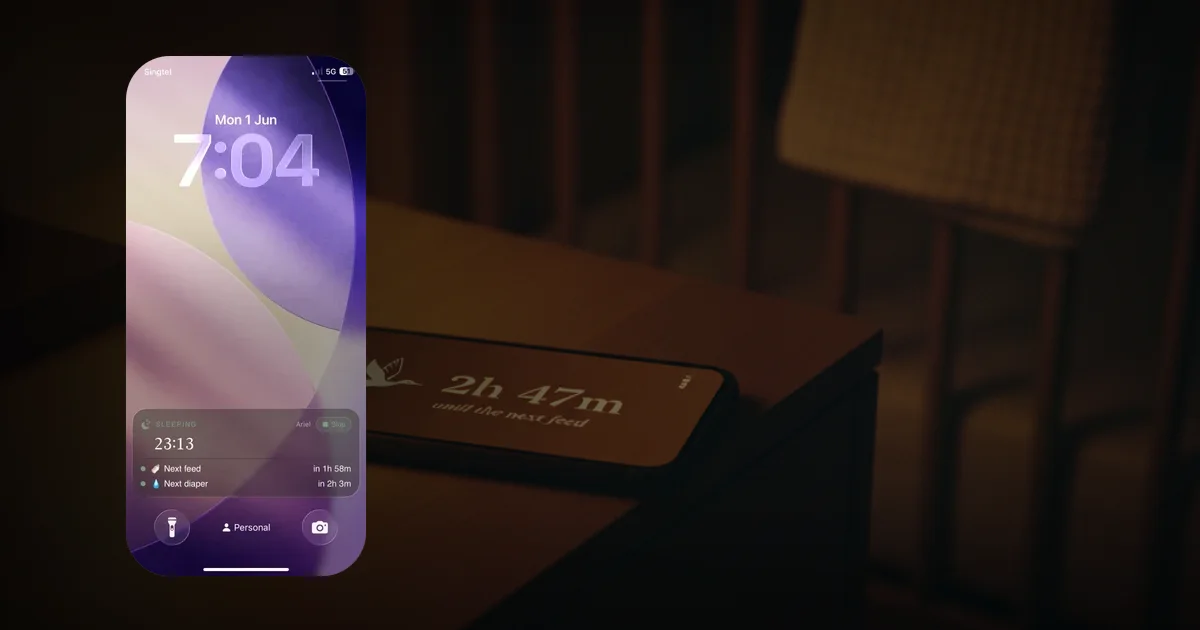
One Baby lets you set a nap or feed target and carry the countdown on your lock screen and Apple Watch. For newborns, that means the next window can live somewhere other than your head. As the weeks change, you adjust the target. The number follows.
You still watch your baby. The screen just remembers the time.
The point
Newborn wake windows are short because newborns are new. Feed, change, hold, notice the early sleepy cues, and start winding down before the room gets loud.
The goal is not a perfect newborn sleep schedule. It is fewer surprises, less guessing, and a day that has a little more shape than yesterday.